
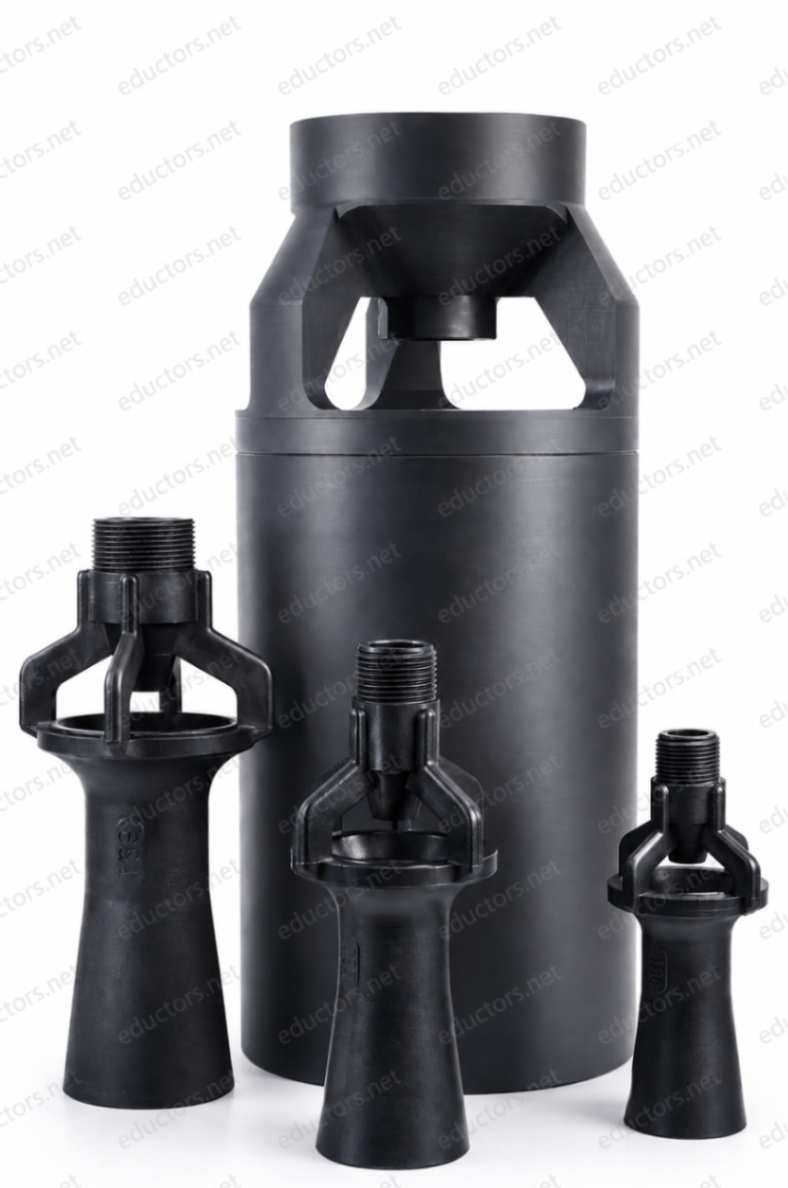
Plastic Tank Eductors — NCI Model TLM
Available in PPL (Glass Reinforced Polypropylene), PVDF (KYNAR®) & PVC. Eductor circulation ratio of supply to discharge is 1:5. Ideal for corrosive chemical service.
Polypropylene Tank Eductors
NCI Tank Eductors are designed for "in-tank" applications. The NCI TLM operates on the principle of flow dynamics — pressurized fluid is accelerated through the nozzle to become a high velocity stream that entrains tank contents and intimately mixes with them. This combined stream exits the NCI TLM at a high velocity creating a flow field capable of causing additional agitation and mixing the tank contents.
The tank eductor's motive fluid may come from two sources. The tank liquid may be re-circulated through the eductor via an external pump or a secondary fluid may be introduced into the tank. Gases, as well as liquids, are used as the secondary fluid. Aeration and gas dispersion for chemical reactions are common uses of gas motive systems. Liquids are typically additives to be mixed with or to dilute the tank contents.
Chemical Resistance (Polypropylene)
Dilute and concentrated Acids, Alcohols, Bases and Mineral Oils
Aldehydes, Esters, Aliphatic Hydrocarbons, Ketones and Vegetable Oils
Aromatic and Halogenated Hydrocarbons and Oxidizing Agents
Design Ratings & Application Data
Design Ratings
- Maximum Temperature: 220°F (104°C)
- Minimum Temperature: 0°F (-18°C)
Application Data
- Minimum Inlet Pressure: 10 psig (70 kPaG)
- Maximum Inlet Pressure: 100 psig (690 kPaG)
Installation Guidelines
An NCI TLM can be mounted in any position. The supply line and manifold piping to multiple TLM's must be sized to supply uniform pressure to each TLM. It is important that the TLM be positioned within the tank so as to insure the free flow of liquid to be mixed into and out of the unit(s). The greatest agitation occurs within the discharge plume; therefore, the discharge end should be aimed towards the most remote part of the tank. On the other hand, the intake end of the unit must be far enough from the tank corner or wall to allow the free flow of liquid into the suction openings.
Tank shape and size influence the placement and number of TLM's required to maintain even agitation or temperature distribution. With no corners to impede liquid flow, the liquid circulates evenly.
In a cylindrical, square, or rectangular tank, the angular intersection of surfaces can interrupt liquid flow patterns and cause liquid stagnation in these areas. Whenever the ratio of length to diameter of the tank is greater than 2:1 (such as tank trucks or railroad cars), it is recommended that multiple TLM's be used. In tanks where a critical velocity must be maintained on the tank bottom, a slight downward angle of the TLM's can be helpful.
KYNAR® (PVDF)
PVDF is a high molecular weight thermoplastic polymer with excellent chemical inertness. It is highly resistant to oxidizing agents and halogens and is almost completely resistant to aliphatic, aromatics, alcohols, acids and chlorinated solvents. It is resistant to most acids and bases. Mechanically strong. High dielectric strength. Thermally stable. Resistant to low temperatures. Stable to ultraviolet and extreme weather conditions. Self-extinguishing and non-toxic.
Quick Facts
- Max recommended temperature: 250°F
- Thermal conductivity (ASTM C 177): 1.32 Btu-inch/hr-ft²-°F
- Specific heat: 0.23 Btu/lb-°F
- Coeff. of linear thermal expansion: 7.1×10⁻⁵
- Applicable temp range for expansion: 50–300°F
Mechanical Properties
- Specific gravity (ASTM D 792): 1.78
- Tensile strength, Ultimate (ASTM D 638): 7,800 p.s.i.
- Elongation at break (ASTM D 638): 80%
- Tensile modulus (ASTM D 638): 3.5×10⁵ p.s.i.
- Rockwell hardness (ASTM D 785): R100
- Impact strength (73°F) (ASTM D 256): 3.0 ft-lb/inch
- Flexural strength (ASTM D 790): 10,750 p.s.i.
- Flexural modulus (ASTM D 790): 3.3×10⁵ p.s.i.
- Coefficient of friction (40 psi, 50 fpm): 0.24 Dynamic
TLM Dimensions
| Model | PPL | KYNAR | Pipe Size | Dim L | Dim D |
|---|---|---|---|---|---|
| TLM00MP | -PP | -KN | 1/4″ NPT Male | 3-1/8″ | 1-1/2″ |
| TLM0MP | -PP | -KN | 3/8″ NPT Male | 4-1/2″ | 2-1/8″ |
| TLM2MP | -PP | -KN | 3/4″ NPT Male | 6-3/8″ | 3″ |
| TLM3MP | -PP | -KN | 1″ NPT Male | 8-1/2″ | 3-3/4″ |
| TLM4MP | -PP | -KN | 1-1/2″ NPT Male | 9-7/8″ | 4-5/8″ |
TLM Performance Table
Nozzle Flow (GPM) at Various Pressures (PSI)
| Model | Free Passage | 10 psi | 15 psi | 20 psi | 25 psi | 30 psi | 35 psi | 40 psi | 50 psi |
|---|---|---|---|---|---|---|---|---|---|
| TLM00MP | 0.188 | 3.2 | 3.9 | 4.5 | 5.0 | 5.5 | 5.9 | 6.3 | 7.1 |
| TLM0MP | 0.288 | 7.5 | 9.2 | 10.6 | 11.9 | 13.0 | 14.0 | 15.0 | 16.8 |
| TLM2MP | 0.386 | 13.5 | 16.5 | 19.1 | 21 | 23 | 25 | 27 | 30 |
| TLM3MP | 0.481 | 21 | 26 | 30 | 33 | 36 | 39 | 42 | 47 |
| TLM4MP | 0.612 | 33 | 40 | 47 | 52 | 57 | 62 | 66 | 74 |
Request a Sizing
Fill out our tank eductor application sheet and we'll reply with the recommended size, price & availability.
Tank Eductor Application FormAvailable Materials
- PPL (Glass Reinforced Polypropylene)
- PVDF (KYNAR®)
- PVC / CPVC (ask about availability)
In Stock
- PPL & PVDF Tank Eductors stocked ¼″, ⅜″, ¾″, 1″ & 1½″ MNPT
- Tank Eductors stocked ⅜″–3″ in Carbon Steel & 316SS
You Might Also Need
Related Products
Liquid Jet Pumps
Pump, transfer, or lift liquids. Carbon Steel, 316SS, Bronze. In stock ½″–3″.
Gas Jet Pumps
Evacuate tanks, purge piping, create vacuum. Steam or air motive. 316SS standard.
Steam Jet Heaters
Inline direct-contact heating. Models 301, 320 & 340. No moving parts.
What's Next?
Continue Your Research
Sizing Calculator
Estimate flow rates and motive requirements for your application.
Product Selector Wizard
Answer 3 questions and get an instant product recommendation.
Request a Quote
Submit your process conditions and we'll size and price it for you.
Prefer to talk it through? Call 1+201-419-6111